Saturday, December 26, 2015

God rest ye, merry, gentle man.

The phone call came in the middle of Christmas evening, freeing us from a hilarious/painful card game, and bringing life and family into clear focus. My Uncle Stan had waited for two of his three sons to arrive and wish him Merry Christmas before escaping the cancer he's been fighting for two years. As with any cancer death, there is relief in the sorrow. Uncle Stan was clear-minded, appreciative of a life well-lived and grateful for the love that surrounded him. He had relatively little pain, and his wife and other care-givers were spared many of the ongoing indignities and cruelties of cancer  - the pain, the loss of bodily control, the dwindling self. 

And still, he is gone. My cousins will again bury a parent taken by cancer. My mom and her surviving brother have lost the big brother who looked out for them all their lives. Last evening when my mom returned to the table after the phone call from my cousin, she said to her surviving brother, "it's just the two of us now." And my sister quickly pointed out that it's the two of them, and their spouses; their children and grandchildren; their nephews and nieces and friends old and new, some of whom grew up with my parents and uncles in the kind of small town that creates friends-who-are-family. They have lost their brother, and they are not alone. 

We will all mourn Uncle Stan in our way. I am reminded again of the circles of grief - to offer support to the inner circles and accept support from circles further out. For me, I have lost one of the several men in my family who are both traditionally masculine - provider, fixer, doer - and gentle souls - a humourist, a musician, a man who felt and loved and displayed his love. When Uncle Stan said "hi sweetheart, how's it going; how are your boys" they were never idle questions. He was the father of sons, the grandfather of grandsons, and knew what it means to raise men. He also never failed to ask, with genuine hope and interest, if I had written anything new. I thought he asked me because he was loving, but then my mom said he asked her often about my writing as well, and ... maybe it makes no difference to anyone else anywhere, but it mattered to me that he was out there waiting to read what I wrote. 

Yesterday was Christmas, and I was reminded, once again, that the best part of Christmas is still my family. An easy, laughter and gift-filled morning with my youngest son, one sister & her partner, and my parents. A small quiet interlude, then dinner at which we were joined by an aunt, uncle and cousin. Much food, slightly less wine, and even more laughter filled my parents' home.

And then the phone call we all expected and did know whether to dread or hope for came, and the voices that had rung with laughter became our comfort. Family. It is our beginning, and if we are truly blessed it is there at the end. 

And so, to my sweet loving Uncle Stan I say, God rest ye, merry, gentle man.  

Just a little video from 2014 of my mom singing with her brother - sorry my voice is louder than theirs. 

Sunday, December 13, 2015

Paper Towns: a book club review

If you want to write compelling characters, captivating stories, and true-to-life detail that makes readers smile, and sigh, and tear up a little - write like John Green. If  you want all that AND for me to to find it completely un-put-down-able so that even while knocked down by the flu I still read way too late into the night, weave Walt Whitman's Leaves of Grass throughout your story in a way that is as illuminating as it is natural.

This is my second John Green book, and his magic is consistent. A part of me wishes his writing was a touch more developed, but since his books are considered Young Adult, I guess that wouldn't work as well for the actual target audience. While The Fault in Our Stars verged occasionally into the morose, Paper Towns suffers mainly from its unrelenting middle-class privilege.

The assumption that all children get a car on their 16th birthday or at graduation, and high school students with their own credit cards, reveals more about the author than it does about the reality of most children in America, let alone the rest of the world. The American middle-class may be culturally dominant, but they are not even a majority in their own country.

I enjoyed Paper Towns - not quite as much as TFIOS, but Paper Towns comes earlier in Green's career, and he's definitely developed his craft. There were a few draggy spots, some of the characters are annoying (being teenagers often has that side-effect), but as I mentioned before, I found it un-put-downable despite its minor flaws. I almost missed my bus stop one morning with a bad case of 'I just need to finish this page.' Ha.

The real magic in Paper Towns are the occasional sparks of wisdom that stick with you. In the mouths of 18 year old they are sometimes slightly contrived, but the Greenian perspective on the world is one worth being exposed to.

------

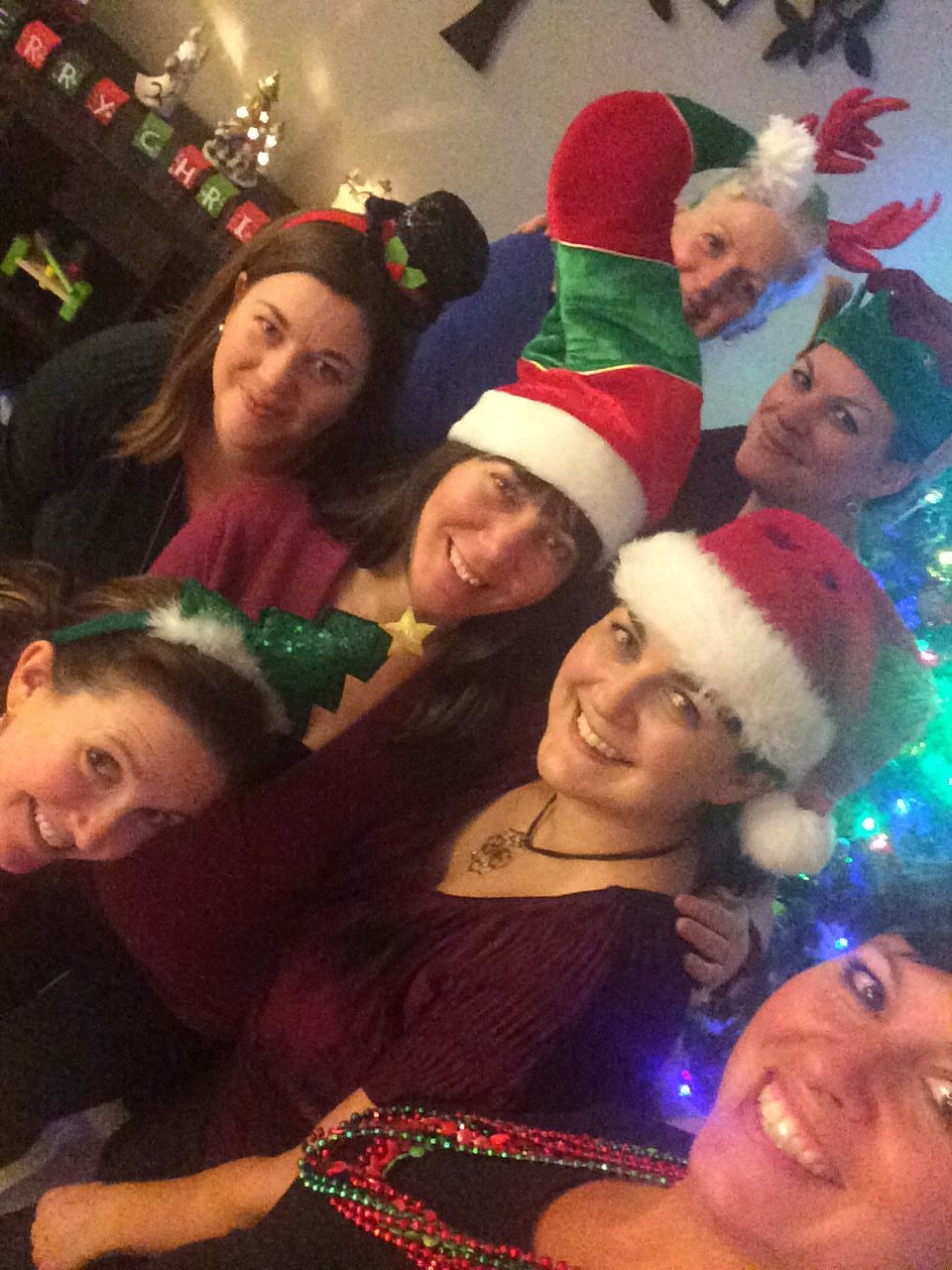
Yay, book club! Especially, yay book club's December Potluck. So much great food. So much fun. And Christmas hats for everyone. What more is there to say. :)

Monday, November 30, 2015

Is Everyone Hanging Out Without Me?: a book club review

This is not a review so much as a string of adjectives, much like Mindy Kaling's book Is Everyone Hanging Out Without Me is not a book so much as a collection of stream-of-consciousness ramblings barfed together inside a 'cute' cover. I think you can see where this is going. On to the adjectives:

- vapid
- completely devoid of mirth
- self-indulgent
- poorly edited
- racist
- sexist
- privileged
- dull
- disjointed
- a vanity publication

I was disappointed when this book club selection was announced and only forced myself through it because I was hosting this month. My only hope was that since Kaling makes her (ever-increasing) living as a comedy writer maybe it would be funny and/or well-written. No luck on either front. To perfect the stupidity, it's sloppily edited - I counted at least 6 missing words and one sentence that just ends.

The nicest thing I can say about this book is that Mindy looks cute on the cover. The second nicest thing is that because she has all the depth and complexity of thought of an adolescent it is over quickly.

--------------------

It had been more than the usual length of time since I got to host book club. Things have been a bit ... different ... since I got home and the original club structures seem to have fallen away.

Still, it's pretty special to have the ladies in my home, and really fun to change things up and have brunch instead of dinner. I do love a good Sunday brunch, from the classic welcoming mimosa to French toast, frittata, steamed asparagus, crisp salad & mini baked goods. Yum yum. There wasn't a lot of book talk, which I normally find frustrating, but given what a waste of paper and ink this book was, it was nice to just connect instead.

Saturday, November 7, 2015

All the Light We Cannot See: a book club review

Even book club reviews have fallen by the wayside of late, but there is so much food for thought in Anthony Doerr's All the Light We Cannot See that I wanted to try to get a few of those thoughts sorted out (full disclosure - I have 20 pages left to read, though really the story is over and the rest seems kind of ... pointless). 

All the Light We Cannot See is rich and poetic and annoying and stilted and incomplete and brimming with the horror of war and the wonder of life. As I said at book club tonight, I don't think I've ever had such a complicated relationship to a book before. It is compelling, but is is not a page turner. I fall asleep every time I try to read it in bed (though that may be due to some other things going on right now), but it holds me rapt when I'm able to focus on it. 

The story takes place, mainly, in the Breton town of Saint Malo during WW2. The young protagonists are a blind French girl - Marie-Laure - and Werner, a German orphan who sees his invitation to the army training school as a way to avoid the otherwise inevitable life and death in the coal mines of his German home town. Both are inquisitive, intelligent adolescents with a curiosity that has questionable benefits. It doesn't pay, in war, to be overly clever; far safer to be unquestioning and placid. Through twists that only the surreal worlds of war and novels can support, Marie-Laure's and Werner's paths inevitably cross, though to say more would be unfair. 

As I said, there's a lot to unpack in Doerr's 500+ densely-written pages. A running reference to 20,000 Leagues Under the Sea, repeated playing of Claire du Lune on a phonograph. The interplay of French civilians - collaborators or resistance or neither, German soldiers, and nominally but irritatingly "movie-star handsome" American soldiers to the rescue. Electronic engineering. The unleashing of man's inhumanity to man. The annoying and expected over-statement of America 'rescuing' Europe. Truly magical explorations of sea life and birds.

Reading this book was like having a rough tag in the back of a cashmere sweater. The chapters are annoyingly short and choppy - generally 2 pages, often shorter. The result is a limping story that jerks back and forth between characters, countries and time periods. It lacks flow. There is a surfeit of characters; I can't say who I would edit out as they are all interesting enough on their own, but they drop away and we lose their stories in a way that is unsatisfactory and incomplete. 

One thing I loved about this story was a thread throughout it that valued a desire for and appreciation of both art and science. Much is made of the Natural History Museum in Paris; Audubon's book of American birds is mentioned repeatedly, and the gathering of knowledge for its own sake is celebrated by the characters. It is not pedantic in the least - it simply and genuinely displays a love of knowledge. And that makes me smile.

I have at least two more blog posts I could write about this book. It seems unlikely that I will. In case I don't, remember this,
“When I lost my sight, Werner, people said I was brave. When my father left, people said I was brave. But it is not bravery; I have no choice. I wake up and live my life. Don't you do the same?”

“To shut your eyes is to guess nothing of blindness. Beneath your world of skies and faces and buildings exists a rawer and older world, a place where surface planes disintegrate and sounds ribbon in shoals through the air. Marie-Laure can sit in an attic high above the street and hear lilies rustling in marshes two miles away. She hears Americans scurry across farm fields, directing their huge cannons at the smoke of Saint-Malo; she hears families sniffling around hurricane lamps in cellars, crows hopping from pile to pile, flies landing on corpses in ditches; she hears the tamarinds shiver and the jays shriek and the dune grass burn; she feels the great granite fist, sunk deep into the earth’s crust, on which Saint-Malo sits, and the ocean teething at it from all four sides, and the outer islands holding steady against the swirling tides; she hears cows drink from stone troughs and dolphins rise through the green water of the Channel; she hears the bones of dead whales stir five leagues below, their marrow offering a century of food for cities of creatures who will live their whole lives and never once see a photon sent from the sun. She hears her snails in the grotto drag their bodies over the rocks.”

A book club review isn't a book club review without a discussion of book club, and - generally more to the point - a discussion of book club dinner. A book set mainly in Brittany is always going to inspire a fabulous meal, and Mrs. S. did not disappoint. In the story itself both fish stew and bread are mentioned. In fact, bread has an important role in carrying messages for collaborators.

Mrs. S asked the local gluten-free bakery if they'd bake a message into a loaf to recreate that, but they were unobliging. It was still delicious bread though, especially paired with a rich, tomatoey, sumptuous halibut stew. Halibut may not be an Atlantic fish (nobody seemed to know), but when your hostess is from the north tip of Vancouver Island and she has access to fresh halibut, you better believe we were too busy chowing down to dock her points on authenticity. 

And the coup de grace ... the piece de resistance ... chocolate eclairs. I kid you not. Oh they were creamy and the pastry was light and the chocolate was so rich. I could live on those chocolate eclairs - not for very long as that shit will kill you, but ... oh they were perfection. 

Saturday, October 3, 2015

autumn ramble

Yesterday was a perfect afternoon for an amble. At the end of a pretty steady week at work and multiple evenings of meetings, a stretch of the legs seemed like the perfect transition back to life. And it was. 

Autumn on the west coast doesn’t have the same vibrant intensity of the Eastern maples, elms, and … whatever other deciduous trees they have that we don’t. It has it’s own beauty though. A softer beauty, perhaps, but one alive with texture, soft colours. In my twenty-minute meander I saw more life than I’ve seen in a long while. 

A tree at the edge of a school yard is bright with green leaves and red apples. This neighbourhood was once farmland, and the reminder of those days makes me smile and wonder what life was like then. Across the highway the hillside is singing with frogs. I can’t see them, but their voices transport me back to the soggy rainforests of Jamaica when rain has eased the heat of the day and the treefrogs are rejoicing in the wetness. 

I enter the trails of Cuthbert Holmes Park and am struck by the wide variety of berries in white and multiple reds on high trees and low shrubs, not to mention the late purple black stragglers on the blackberry brambles. I imagine the Thanksgiving centrepiece the red and white would make. I am not the only one captured by the berry bounty - a fat grey squirrel is munching down on a bush of crimson globes that look to be bursting with juice and flavour - when I stop to photograph him he pauses in his meal, but quickly decides that the reward of the pincherries(?) is worth the risk of my presence. 

Cuthbert Holmes Park is popular with dog walkers so there are always people and pets to greet on their way. One gentlemen had two of my dream dog - the most perfect golden retrievers. Well behaved, beautifully groomed, friendly, but not overly so. 

From the bridge crossing Colquitz Creek I’m surprised to see a male mallard duck, though he’s far enough away I don’t stop to watch for long. Around the corner and through another abandoned orchard I startle a feral bunny. This part of the city is full of them, though oddly you are more likely to see them on from the highway than in the park. I suppose the park is their territory where they usually move before I get near enough to see them. This was a small one. And fast. The poodle approaching from the other direction missed out on a good chase. 

With that kind of life to observe, the walk passes quickly. I run my errands, head back to the mall entrance, and see the day has turned from bright sunshine to steady rain. That is another feature of the westcoast autumn - as a trade off for the duller foliage we avoid the flooding, freezing downpours of the east coast, though our weather changes in a moment. I could wait it out, but - as my dad? mom? grandpa? - used to say, I'm not made of sugar - the rain won't melt me. Other walkers, mostly still with their dogs and much better prepared for the weather than I am, continue to greet me on the paths. 

I get back to the bridge, and Mr. Drake has been joined by a small group of friends who look happy with the rain. Personally, I don't have the same ability to let water roll of my cotton-clad back and by the time I near home I’m looking forward to flannel pjs, a hot tea, and a quiet evening in. And I can't stop smiling. Even here on the edge of the city the healing powers of nature are able to weave their magic.


Related Posts Plugin for WordPress, Blogger...